Before going further, it is useful to clarify the names, because Magento and Adobe Commerce are often used interchangeably, even though they do not refer to exactly the same product.
This time, Adobe wrote it down.
For the MariaDB community, this is excellent news, but it also brings responsibility.
MariaDB support in the Magento and Adobe Commerce ecosystem is certainly not new.
Magento, Magento Open Source and Adobe Commerce
For Adobe Commerce 2.4.9 on Cloud, Adobe currently recommends MariaDB 12.3 and also supports MariaDB 11.8. MySQL is no longer listed in the Cloud requirements.
This shared origin matters. It explains why migrating an application such as Adobe Commerce from MySQL to MariaDB is fundamentally different from rewriting it for an unrelated database platform.
The exact destination version must also match the Adobe Commerce release being used.
This is the future direction of Adobe Commerce, and, I must admit, this is very nice to read.
- Magento Open Source is the freely available open-source edition.
- Adobe Commerce is Adobe’s commercial enterprise platform built on the same Magento foundation.
- Adobe Commerce on Cloud Infrastructure is Adobe Commerce operated using Adobe’s managed cloud environment.
More importantly, Adobe has announced that:
From supported alternative to default platform
A database migration still requires preparation.
The transition did not stop with MariaDB 11.4.
For Adobe Commerce 2.4.5, 2.4.6 and 2.4.7, the situation is also clear. MySQL 8.0 reached Adobe’s end-of-support date on April 30, 2026, and Adobe does not intend to make those Commerce releases compatible with a later MySQL major version.
For Adobe Commerce 2.4.8, MySQL 8.4 remains available, but it is the end of the MySQL road.
To everyone preparing for that journey: welcome to MariaDB.
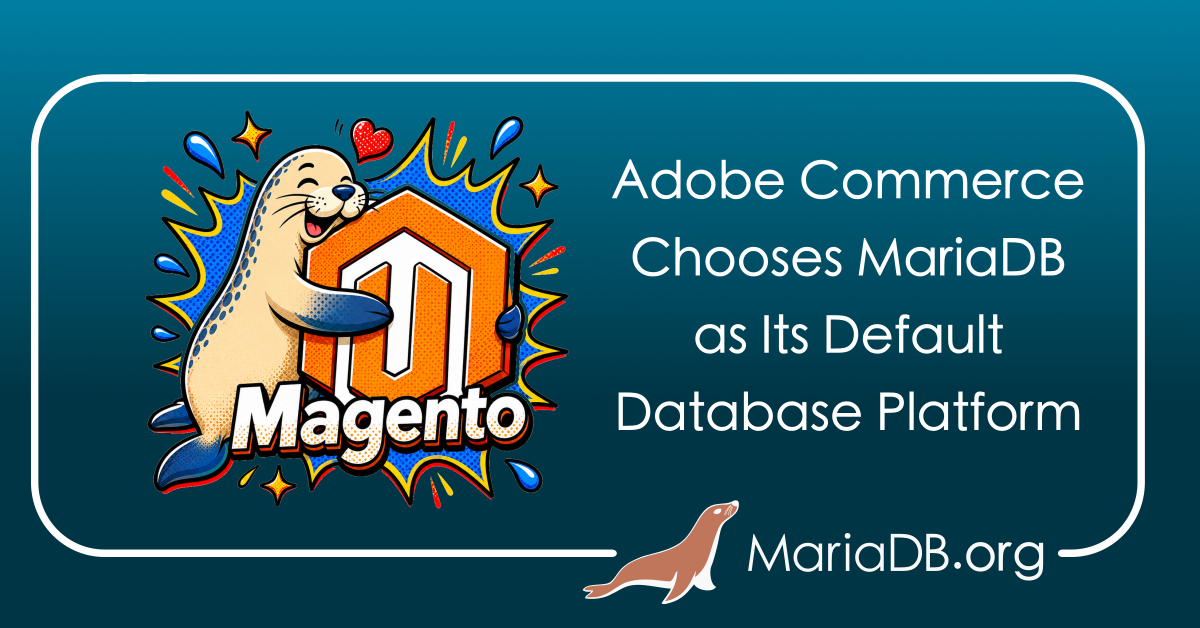
Adobe Commerce has made its direction clear: MariaDB is no longer simply one supported database among several. It is becoming the default database platform for the future of Adobe Commerce.
Adobe Commerce 2.4.9 on-premises still supports MySQL 8.4 alongside MariaDB 12.3. However, MySQL 8.4 is the final MySQL release Adobe intends to certify, while MariaDB is the default and recommended platform going forward.
Migration planning should therefore not be postponed until the final security update of an existing database version.
Adobe Commerce 2.4.8 and 2.4.9 are the last Adobe Commerce releases that support MySQL.
Adobe’s managed Commerce cloud infrastructure has used services backed by MariaDB for years. Interestingly, the service is still called mysql in configuration files, even though Adobe’s own documentation explains that the persistent database service is based on MariaDB.
But users should take Adobe’s roadmap seriously.
But the recent announcements make the direction much clearer.
MariaDB did not appear from another galaxy with an SQL syntax that happened to look vaguely familiar.
Mage-OS is particularly interesting because it represents the community-driven side of the Magento ecosystem. Its installer detects both MySQL and MariaDB, but the recommended database listed for Mage-OS 3 is MariaDB.
The compatibility table is already moving
The same direction is visible outside Adobe Commerce.
MariaDB Migrator can also help assess and orchestrate the database transition, including schema, data, users, and validation.
You already know much of this world. Your SQL skills still matter. Your operational experience still matters. Most of your tools and application knowledge still matter.
If you need help, you know where to find us 😉
But they still share a considerable amount of history, protocol compatibility, SQL behavior and ecosystem knowledge.
For older supported Adobe Commerce releases that cannot move beyond MySQL 8.0, MariaDB is the supported migration destination.
“MySQL is named after my daughter My, and MariaDB after my youngest daughter Maria. For me it has always been one family. If you are coming from MySQL, you are coming home: your SQL, your tools and your experience all work here, and we will do our best to keep it that way.”
This is not simply MariaDB being added to another compatibility table.
And the community distribution is coming too
Adobe strongly advises on-premises users of those releases to migrate their database servers to a compatible MariaDB version.
For users arriving from MySQL, the message should not be: “You chose the wrong database.”
The ecosystem is not being split by this database transition. It is converging around MariaDB.
MySQL 8.4 is therefore the final MySQL version Adobe intends to certify. No later MySQL release will be supported by Adobe Commerce.
Adobe Commerce 2.4.8, released on April 8, 2025, introduced support for MariaDB 11.4 LTS alongside MySQL 8.4 LTS.
A family story
It comes directly from the MySQL lineage and was created by people who had already spent many years building MySQL.
Sometimes a change happens progressively, one compatibility matrix at a time, until somebody finally writes down what has already become obvious.
It should be: welcome.
The products have evolved independently, and nobody should pretend that modern MySQL and MariaDB are identical. There are differences in features, optimizers, replication, authentication, JSON behavior, operational tooling and release strategies.
In its database compatibility guidance for Adobe Commerce, Adobe now describes MariaDB as the default and recommended database platform going forward.
The sea lion has been expecting you.
There is, of course, some history here.
For Adobe Commerce 2.4.9 and future releases, MariaDB is the platform Adobe is actively carrying forward.
Adobe Commerce and the community distribution are therefore traveling in the same direction.
The requirements are actively following new MariaDB releases.
The current product family can therefore be simplified as follows:
More Adobe Commerce and Magento users will arrive with real production systems, large catalogues, demanding availability requirements and years of operational habits built around MySQL.
Names have history. Infrastructure sometimes moves faster than terminology.
Now that this is clarified, let’s continue…
What should Adobe Commerce users do?
For the latest Adobe Commerce 2.4.8 patch releases, Adobe lists MariaDB 11.4 and 11.8, with MySQL 8.4 still available as the final MySQL option.
Mage-OS 3.0, released in May 2026 and built on Magento Open Source 2.4.9, recommends MariaDB 11.4 in its software stack.
Adobe Commerce 2.4.9 followed on May 12, 2026. With this release, MySQL 8.0 and MariaDB 10.6 disappeared from the system requirements, while support moved towards newer MariaDB releases.
Personally, I am curious to see how Magento developers will include all the great features that make perfect sense for an e-commerce site, such as Application-Time Periods, Full-Text Indexes (including Mroonga), Vector Similarity Search, and more.
Applications and extensions should be tested. SQL modes, collations, character sets, authentication, backups, monitoring and replication configurations should be reviewed. Query plans should be compared, and the complete Commerce test suite should be executed against the target MariaDB release.
This is perhaps the most important part of the announcement. Adobe is not merely preserving MariaDB as a compatibility option while waiting to decide what comes next.
At the time Adobe Commerce 2.4.8 was released, MariaDB 11.4 was the important new LTS target. Adobe presented it as the recommended MariaDB version, with a long maintenance lifetime suitable for enterprise deployments.
Magento is an e-commerce platform originally created as an independent open-source project. It provides the main components required to operate an online shop, including the product catalogue, shopping cart, checkout, customer accounts, orders, promotions, inventory and administration interface. [1]
MariaDB is becoming the path forward.
There will be differences to learn, of course, but this is a migration within a family, not a journey to an entirely unknown planet; we are the same ecosystem!
Welcome aboard
For users of Adobe Commerce 2.4.8 and 2.4.9, Adobe also recommends beginning that migration planning now.
Nobody should migrate a production Commerce database only because a cheerful sea lion appeared in a blog post.
Adobe acquired Magento in 2018. The commercial product previously known as Magento Commerce was subsequently renamed Adobe Commerce and became part of the wider Adobe Experience Cloud ecosystem. Adobe Commerce continues to be built on the Magento technology and codebase, but adds commercial and enterprise-oriented capabilities, support services, cloud deployment options and integrations with other Adobe products. Adobe itself describes Magento Open Source as the foundation of Adobe Commerce.
They will have questions. They may discover compatibility problems. They may find query plans that behave differently. They may also need help with the new migration tool, documentation and performance guidance.
— Michael “Monty” Widenius
The current Adobe Commerce requirements have already progressed further.