In our minimal version, Field_money is responsible for:
The deep value of the framework lies not only in extensibility but also in coverage.
This is the piece many people overlook.
In our minimal version, Type_handler_money inherits from Type_handler_newdecimal to focus on the plugin architecture rather than implementing every numeric behavior from scratch.
This design goal deserves to be clearly stated: MariaDB does not wish to make a conceptual distinction between “native” and “plug-in” types. Just as storage engines are all plug-ins within a common framework, data types are also expected to adhere to a uniform interface.
- how a column of that type is represented,
- how values are stored and read,
- how values are exposed to clients,
- how the type interacts with other types in expressions.
This is where the runtime behavior lives.
From there, you need to teach the server a small set of related behaviors:
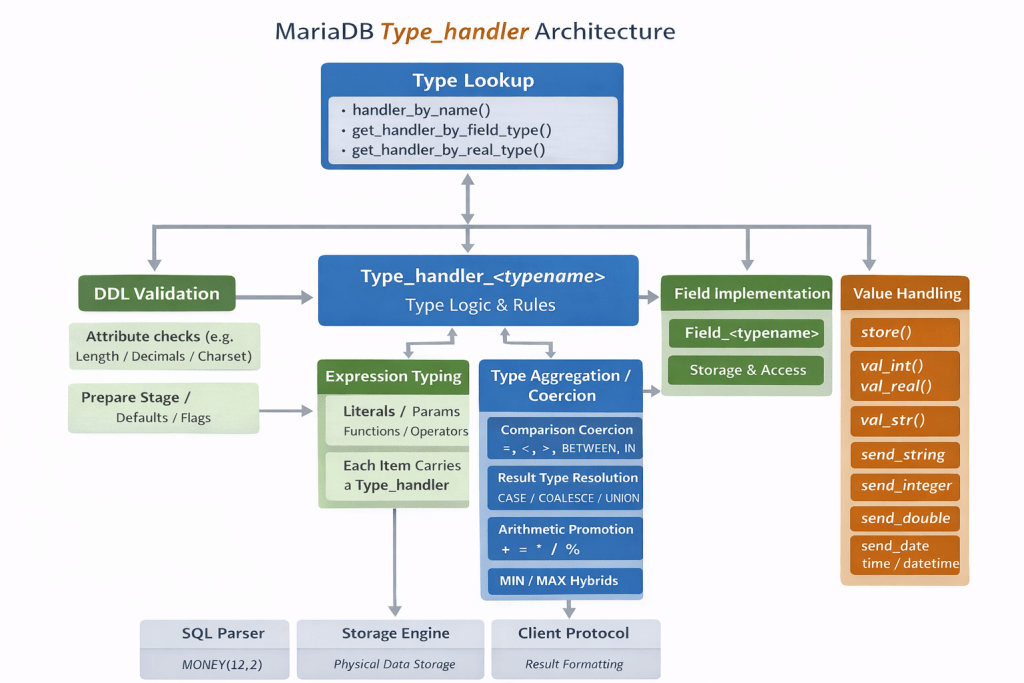
Thanks to this new type of architecture, it is much easier to understand these responsibilities. Instead of treating a type as a single, giant, opaque object, MariaDB divides the work across a few components.
Type_handler_gives the type its identity and acts as the factory.Field_implements runtime storage and behavior for a column value.Type_collection_decides how the type combines with other types.- the plugin declaration registers the type so the server can load it.
This is the first part of the series about how to add a new data type to MariaDB using the Type_handler framework. A preliminary article has already been published to start the series; it covers how to set up your development environment and compile MariaDB Server: Adding a New Data Type to MariaDB with Type_handler – Part 0.
A custom MariaDB type needs to answer three questions: how to build the field, how to store and read values, and how to behave in expressions.
In the old world, adding a new data type required modifying numerous independent code paths, while hoping not to overlook any. In the new world, the server is structured such that, if the Type_handler interface is complete, the main type-specific behavior is taken into account from the design phase.
When you add a new type to MariaDB, you are not only adding a new SQL keyword. Historically, that kind of work required invasive changes across the parser, optimizer, protocol, replication, and type-conversion mechanisms.
Field *Type_handler_money::make_table_field_from_def(TABLE_SHARE *share,

MEM_ROOT *root,

const LEX_CSTRING *name,

const Record_addr &rec,

const Bit_addr &bit,

const Column_definition_attributes *attr,

uint32 flags) const override;
This class defines the type’s identity.
SELECT amount + 1;

SELECT amount + 1.5;

SELECT amount = 10;
Now that we are more familiar with the Type_hander architecture, the next article will be dedicated to building a small working new MONEY data type.
For this series, keep this model in mind:
static struct st_mariadb_data_type plugin_descriptor_type_money=

{

MariaDB_DATA_TYPE_INTERFACE_VERSION,

&type_handler_money

};
maria_declare_plugin(type_money)
{
MariaDB_DATA_TYPE_PLUGIN,
&plugin_descriptor_type_money,
"money",
"lefred",
"Data type MONEY",
PLUGIN_LICENSE_GPL,
0,
0,
0x0001,
NULL,
NULL,
"0.1",
MariaDB_PLUGIN_MATURITY_EXPERIMENTAL
}
maria_declare_plugin_end;
That is why Type_handler is such a good place to start.
2. Field_money
The point of the pluggable type framework is to replace that scattered surgery with one uniform abstraction: Type_handler.
To add our new MONEY data type, we will need to prepare 4 major components.
amount MONEY(12,2)
It controls coercion and aggregation rules in expressions such as:
When MariaDB parses a column definition like:
The single most important method is:
4. Plugin registration
If you need to remember one sentence, it should be this:
If Type_handler_money answers “what type is this?”, then Field_money answers “what does this type do?”.
Finally, the plugin declaration exposes the type to the server: