sudo apt update
sudo apt install cloud-init -y
/usr/bin/cloud-init 26.1-0ubuntu2
sudo mkdir -p /var/lib/cloud/seed/nocloud-net
sudo cloud-init clean –logs
………………………..status: done
For example:
- Creating users
- Adding SSH keys
- Installing packages
- Setting hostnames
- Running startup commands
Create the seed directory structure:
- Detect – Determines which datasource or platform the server is running on.
- Local – Performs early system setup tasks before networking is available.
- Network – Brings up networking and connects to the datasource.
- Config – Applies most of the configuration modules from your user-data file.
- Final – Runs the last setup tasks, including package installs and custom commands.
sudo cloud-init schema –config-file ~/user-data.yaml
By the time the server finishes booting and you can SSH into it, where cloud-init has already completed all these stages and applied your configuration.
On official Ubuntu 26.04 cloud images, cloud-init is already installed and enabled by default. However, if you’re using a regular desktop installation, a bare-metal server, or a manually created local VM, you may need to install it yourself.
cloud-init actually does at boot, who’s still configuring servers by hand.Install cloud-init on Ubuntu 26.04
cloud-init status –wait
sudo reboot
When something goes wrong, the 2 log files tell you everything:
cloud-init status
You can display your public key using:
Check the cloud-init Status
Before creating or testing any configuration, it’s a good idea to verify that cloud-init is working properly on the current system.
Before using your user-data file on a real server, validate it with the built-in cloud-init schema checker, which is important because YAML formatting mistakes are very easy to miss. A single indentation error or invalid key can cause part of your configuration to fail silently during the first boot.
#cloud-config
# Create a new user with sudo access
users:
– name: tecmint
groups: sudo
shell: /bin/bash
sudo: [‘ALL=(ALL) NOPASSWD:ALL’]
ssh_authorized_keys:
– ssh-ed25519 AAAAC3NzaC1lZDI1NTE5AAAA <your-public-key>
# Install packages on first boot
packages:
– vim
– htop
– git
– ufw
package_update: true
package_upgrade: true
# Set the hostname
hostname: tecmint-server
# Write a custom motd
write_files:
– path: /etc/motd
content: |
Welcome to TecMint Server
Managed by cloud-init on Ubuntu 26.04
# Run commands after packages are installed
runcmd:
– ufw allow OpenSSH
– ufw –force enable
Run the validation command like this:
Error: cloud-config is not valid:
– ‘users.0.sudo’ is not valid under any of the given schemas
For a fast summary of what ran and what failed:
Important: cloud-init clean removes all state, including user-data that was applied before. On a production system, this triggers a full re-run, which can re-create users, reinstall packages, and overwrite files.
Knowing the active datasource helps a lot when troubleshooting why a user-data file was or wasn’t detected during boot.
#cloud-config
If you’ve ever installed a fresh Ubuntu server and spent the next 20 minutes creating users, installing packages, configuring SSH keys, and adjusting networking manually, cloud-init can save yourself a lot of repetitive work.
ssh-ed25519 AAAAC3NzaC1lZDI1NTE5AAAAIBTvMBRGqRTCCjFEXvmD7TjJkwBpO3X8QZ9vYmK2sNpA ravi@tecmint-server
doctl compute droplet create tecmint-server
–image ubuntu-26-04-x64
–size s-1vcpu-1gb
–region nyc1
–user-data-file ~/user-data.yaml
On AWS (EC2):
You can also inspect the additional configuration files loaded by cloud-init:
One important thing beginners should know is that cloud-init errors are not always obvious. A small YAML formatting mistake or invalid command may cause part of the configuration to fail quietly during boot. The server still starts, but some tasks may never run.
/etc/cloud/cloud.cfg– the main system config, controls which modules run and in which order./etc/cloud/cloud.cfg.d/– drop-in config overrides, loaded aftercloud.cfg./var/lib/cloud/– runtime data, including theuser-datacloud-init received on first boot./var/log/cloud-init.log– detailed per-module execution log./var/log/cloud-init-output.log– stdout/stderr from every commandcloud-initran.
cloud-init is a Linux initialization service that runs automatically during the very first boot of a new server instance, and its job is to configure the system before you ever log in.
Breaking down the key sections:
detail: DataSourceNoCloud
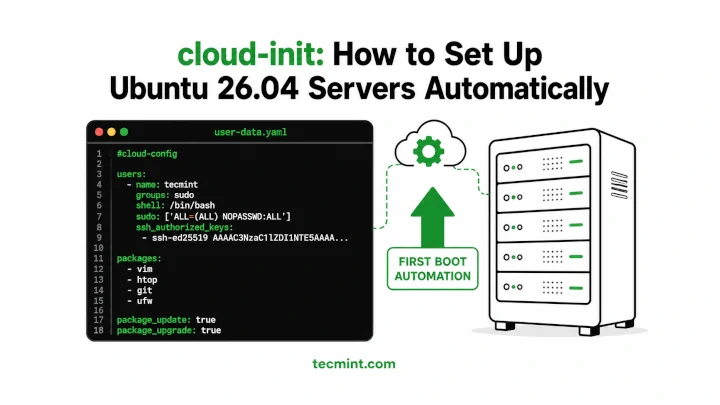
The user-data file is the heart of cloud-init, where you define everything the server should do automatically during its first boot.
05_logging.cfg– Controls wherecloud-initwrites its logs.90_dpkg.cfg– Added by Ubuntu’s package system and tellscloud-initto use apt for package management.99-disable-network-config.cfg– Preventscloud-initfrom modifying network settings, which is the default behavior on Ubuntu systems that use Netplan to manage networking.curtin-preserve-sources.cfg– Helps preserve APT repository settings during installations performed with Curtin, Ubuntu’s automated installer backend.
cloud-init status –long
sudo cp ~/user-data.yaml /var/lib/cloud/seed/nocloud-net/user-data
ssh-keygen -t ed25519 -C “ravi@tecmint-server”
cat ~/.ssh/id_ed25519.pub
Once this file is ready, you can pass it to a cloud provider or test it locally in a virtual machine using the NoCloud datasource.
total 20
-rw-r–r– 1 root root 2071 Aug 13 2025 05_logging.cfg
-rw-r–r– 1 root root 348 May 27 11:54 90_dpkg.cfg
-rw-r–r– 1 root root 28 May 27 13:16 99-disable-network-config.cfg
-rw-r–r– 1 root root 167 Aug 13 2025 README
-rw-r–r– 1 root root 35 May 27 10:30 curtin-preserve-sources.cfg
Cloud-init is the initialization service used by most cloud platforms and virtual machine images. It reads configuration data during the first boot of a Linux system and automatically applies settings like hostname changes, user creation, SSH configuration, package installation, and startup commands.
cloud-init analyze show
cloud-init takes the repetitive first-boot setup off your hands and puts it into a version-controllable YAML file. You covered how to install and verify cloud-init on Ubuntu 26.04, how to write a user-data config that creates users, installs packages, and runs commands, and how to test that config locally using the NoCloud datasource before pushing it to a real cloud instance.
In the Droplet creation UI, scroll to the “Advanced Options” section and check “Add Initialization scripts (free)“. Paste the contents of your user-data.yaml directly into the text field.
Before creating your first cloud-init configuration, it helps to understand where the important files and logs are stored on Ubuntu.
users– creates thetecmintuser, adds them tosudo, and injects the SSH key.packages– installs vim, htop, git, and ufw via apt.package_update: true– runsapt updatebefore installing.package_upgrade: true– runsapt upgradeto apply pending security patches.hostname– sets the system hostname so you’re not staring at a random cloud-generated name.write_files– drops arbitrary file content to any path on the filesystem.runcmd– runs shell commands in order, after all other modules finish.
One important line here is:
Test the Config with cloud-init Schema Validation
Reboot the machine:
Using the DigitalOcean CLI (doctl):
When launching a real cloud instance, you pass the user-data file at creation time through your provider’s interface or CLI. The process is the same across providers, only the tooling differs.
On a local VM or a homelab server where you don’t have a cloud provider metadata service, you can test your user-data config using the NoCloud datasource, which is the cleanest way to iterate on configs without spinning up real cloud instances.
Valid cloud-config: /home/ravi/user-data.yaml
status: done
extended_status: done
boot_status_code: enabled-by-generator
last_update: Thu, 01 Jan 1970 00:00:27 +0000
detail: DataSourceNoCloud [seed=/var/lib/cloud/seed/nocloud-net]
errors: []
recoverable_errors: {}
In most cases, you won’t need to edit /etc/cloud/cloud.cfg directly, because the real configuration work usually happens inside the user-data YAML file you provide when creating the server instance.
That’s why checking the cloud-init logs should always be your first troubleshooting step after deploying a new instance.
Start by checking whether cloud-init is already available on your system:
It reads a configuration file called user-data, which contains instructions written in YAML format, and depending on your environment, this file can be provided in several ways:
Ubuntu cloud images already include cloud-init by default, but understanding how it works gives you much better control over automated server deployments. Once you get comfortable with it, spinning up new servers becomes far less repetitive.
cloud-init –version
ls -l /etc/cloud/cloud.cfg.d/
Cloud-init v. 26.1-0ubuntu2 running ‘init-local’ at Fri, 29 May 2026 05:32:28 +0000. Up 3.72 seconds.
Cloud-init v. 26.1-0ubuntu2 running ‘init’ at Fri, 29 May 2026 05:32:29 +0000. Up 4.06 seconds.
ci-info: +++++++++++++++++++++++++++Net device info++++++++++++++++++++++++++++
ci-info: +——–+——-+———–+———–+——-+——————-+
ci-info: | Device | Up | Address | Mask | Scope | Hw-Address |
ci-info: +——–+——-+———–+———–+——-+——————-+
ci-info: | enp1s0 | False | . | . | . | 52:54:00:d4:f7:a2 |
ci-info: | lo | True | 127.0.0.1 | 255.0.0.0 | host | . |
ci-info: +——–+——-+———–+———–+——-+——————-+
…
Cloud-init v. 26.1-0ubuntu2 running ‘modules:config’ at Fri, 29 May 2026 05:32:30 +0000. Up 5.85 seconds.
Cloud-init v. 26.1-0ubuntu2 running ‘modules:final’ at Fri, 29 May 2026 05:32:32 +0000. Up 7.93 seconds.
…
The following NEW packages will be installed:
git git-man htop liberror-perl
0 upgraded, 4 newly installed, 0 to remove and 17 not upgraded.
Need to get 5,630 kB of archives.
After this operation, 28.8 MB of additional disk space will be used.
…
Setting up htop (3.4.1-5build2) …
Setting up git (1:2.53.0-1ubuntu1) …
Rules updated
Rules updated (v6)
Firewall is active and enabled on system startup
Cloud-init v. 26.1-0ubuntu2 finished at Fri, 29 May 2026 05:32:52 +0000. Datasource DataSourceNoCloud [seed=/var/lib/cloud/seed/nocloud-net]. Up 27.22 seconds
2026-05-29 05:32:55,321 – stages.py[DEBUG]: Running module package-update-upgrade-install …
2026-05-29 05:32:55,004 – util.py[WARNING]: Failed to run command: [‘apt’, ‘install’, ‘-y’, ‘htop’]
2026-05-29 05:32:55,005 – util.py[WARNING]: exit code: 100
Have you run into a cloud-init issue that wasn’t obvious from the logs? Drop it in the comments and describe what your config was trying to do.
Once the server starts, cloud-init reads the configuration and begins applying the tasks you defined, such as:
For more detailed information, use the extended status command:
sudo less /var/log/cloud-init.log
sudo less /var/log/cloud-init-output.log
sudo cat /var/log/cloud-init-output.log
The cloud-init boot process is divided into five stages:
sudo tail -50 /var/log/cloud-init.log
Start with the schema validation step, cloud-init schema --config-file, before you deploy anything. Catching a YAML indentation error locally takes 2 seconds. Catching it after you’ve launched 20 instances takes much longer.
Debug cloud-init Failures
As you start troubleshooting or customizing cloud-init behavior, these directories become very useful for understanding what happened during boot and why a configuration did or didn’t apply correctly.
If you see an error state, the first thing to check is the cloud-init log files:
nano ~/user-data.yaml
The file must be written in YAML format and the very first line must contain the following header. If it’s missing, cloud-init treats the file as plain text and ignores the configuration completely.
sudo touch /var/lib/cloud/seed/nocloud-net/meta-data
status: done
Here are the main directories and files you’ll work with most often:
Fix every validation error before deploying the configuration to real systems.